Ed eccoci arrivati alla quarta ed ultima parte del post "THE LAMIA". In questo post pubblicherò il testo della canzone "The Lamia" dei Genesis.
Ma prima voglio dirvi alcune cose!
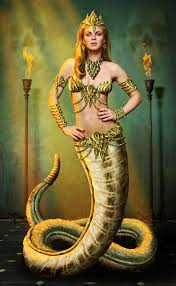
I Greci antichi credevano che le Lamia fossero dei vampiri che rapivano i bambini per succhiarne il sangue. Esse erano raffigurate come dei serpenti con il corpo di una donna.
Secondo un'altra storia, invece, Lamia era una regina libica che si innamorò di Zeus. Purtroppo, però, la gelosa moglie di Zeus, Era, la trasformò in un mostro e uccise i suoi figli. Essa la rese, inoltre, incapace di chiudere gli occhi cosicchè le era impossibile addormentarsi e dimenticare almeno per un po' la terribile immagine della morte dei suoi figli.
Quando Zeus vide tutto ciò, ebbe pietà di Lamia e così le fece il dono di poter rimuovere gli occhi dalle orbite e poi rimetterli al loro posto di nuovo.
In questo modo, sebbene impossibilitata al riposo, ella potè almeno dimenticare per un po' la sua sfortuna.
Pare che, ancora oggi, i Greci dicano ai bambini, per farli spaventare: Guarda che arriva Lamia, invece che l'uomo nero che chiamiamo noi!
Non è fantastico?
We have come to the fourth and last part of the post "THE LAMIA".
The ancient Greeks thought that the Lamia were vampires which kidnapped children to suck their blood. It seems that, nowadays, Greeks still use this mythological figure to frighten their children!
Isn't it incredible?
THE LAMIA, GENESIS (from "The Lamb Lies Down on Broadway, 1974)
The scent grows richer, he knows he must be near.
He find a long passageway lit by chandeleir.
Eache step he takes, the perfumes change, from familiar fragrance to flavours strange.
A magnificent chamber meets his eye.
Inside, a long rose-water pool is shrouded by fine mist.
Stepping in the moist silence, with a warm breeze he's gently kisse.
Thinking he is quite alone, he enters the room as if it were his own.
But ripples on the sweet pink water reveal some company unthought of.
Rael stand astonished doubting his sight, struck by beauty, gripped in fright;
Three vermilion snakes of female face, the smallest motion, filled with grace.
Muted melodies fill the echoing hall, but there is no sign of warning in the siren's call:
"Rael, welcome! We are the Lamia of the pool.
We have been waiting for our waters to bring you cool."
Putting fear beside him, he trusts in beauty blind.
He slips into the nectar, leaving his shredded clothes behind.
With thir tongues, they test taste and judge all that is mine.
They move in a series of caresses that glide up and down my spine.
As they nibble the fruit of my flesh I feel no pain,
Only a magic that a name would stain.
With the first drop of my blood in their veins, their faces are convulsed in mortal pains.
The fairest cries, "We all have loved you Rael."
Each empty snake-like body floats,
Slet sorrow in empty boats.
A sickly sourness fills the room;
The bitter harvest of a dying bloom.
Looking for motion I know I will not find.
I stroke the curls now turning pale in which I'd lain entwined.
"O' Lamia, your flesh that remains I will take as my food;
It is the scent of galric that lingers on my chocolate fingers."
Looking behind me, the water turns icy blue
The lights are dimmed andd once again the stage is set for you.
Il profumo si fa più intenso. Egli sa d'esser vicino.
Si imbatte in un lungo corridoio illuminato da candelabri.
Ad ogni passo che fa, i profumi cambiano da fragranze familiari a sconosciuti aromi.
Una sala magnifica incontra i suoi occhi.
All'interno, una lunga vasca d'acqua rosa è avvolta da nebbia sottile.
Camminando nell'umido silenzio, da una calda brezza viene baciato.
Pensando d'esser solo, entra nella stanza come fosse la sua
Ma onde sulla dolce acqua rosa rivelano una compagnia inaspettata.
Rael resta attonito, dubitando della sua vista, folgorato dalla bellezza, preso dal panico;
Tre serpenti vermigli con volti di donna, dalle piccole movenze piene di grazia.
Mute melodie riempiono la sala echeggiante, ma non c'è alcun segno d'allarme nel richiamo delle sirene: "Rael, benvenuto! Noi siamo le Lamia della piscina.
Aspettavamo da tanto che le nostre acque ti portassero refrigerio."
Lasciandosi la paura alle spalle, egli ha fiducia nella cieca bellezza.
Egli scivola nel nettare, lasciando i suoi vestiti strappati dietro di sè.
Con le loro lingue esse assaggiano, assaporano e giudicano tutto ciò che è mio.
Si muovono in una serie di carezze che corrono su e giù lungo la mia schiena.
Mentre mordono il frutto della mia carne, non sento alcun dolore,
Ma soltanto un'estasi che un nome macchierebbe.
Con la prima goccia del mio sangue nelle loro vene, i loro volti si contraggono in smorfie mortali.
La più bella urla: "Tutte noi ti abbiamo amato, Rael."
Ogni corpo serpentino galleggia inanimato,
Muto dolore in barche vuote.
Una nauseante acidità riempie la stanza;
L'amaro raccolto di una bellezza morente,
Cercando la vita so che non ne troverò.
Accarezzo le spire già pallide in cui ero rimasto avvinto.
"Oh Lamia, ciò che resta del vostro corpo mi nutrirà;
E' l'odore dell'aglio che resiste sulle mie dita di cioccolato."
Guardando dietro di me, l'acqua diventa di un gelido blu.
Le luci si abbassano e una volta ancora la scena è pronta per te.
Traduzione di Ipazia
http://www.youtube.com/watch?v=jWRrQ6GlI8o