
dal sito del MoMa di New York dove è esposta l' opera originale di Hopper
Edward Hopper and the House by the Railroad
Out here in the exact middle of the day,
This strange, gawky house has the expression
Of someone being stared at, someone holding
His breath underwater, hushed and expectant;
This house is ashamed of itself, ashamed
Of its fantastic mansard rooftop
And its pseudo-Gothic porch, ashamed
of its shoulders and large, awkward hands.
But the man behind the easel is relentless.
He is as brutal as sunlight, and believes
The house must have done something horrible
To the people who once lived here
Because now it is so desperately empty,
It must have done something to the sky
Because the sky, too, is utterly vacant
And devoid of meaning. There are no
Trees or shrubs anywhere--the house
Must have done something against the earth.
All that is present is a single pair of tracks
Straightening into the distance. No trains pass.
Now the stranger returns to this place daily
Until the house begins to suspect
That the man, too, is desolate, desolate
And even ashamed. Soon the house starts
To stare frankly at the man. And somehow
The empty white canvas slowly takes on
The expression of someone who is unnerved,
Someone holding his breath underwater.
And then one day the man simply disappears.
He is a last afternoon shadow moving
Across the tracks, making its way
Through the vast, darkening fields.
This man will paint other abandoned mansions,
And faded cafeteria windows, and poorly lettered
Storefronts on the edges of small towns.
Always they will have this same expression,
The utterly naked look of someone
Being stared at, someone American and gawky.
Someone who is about to be left alone
Again, and can no longer stand it.
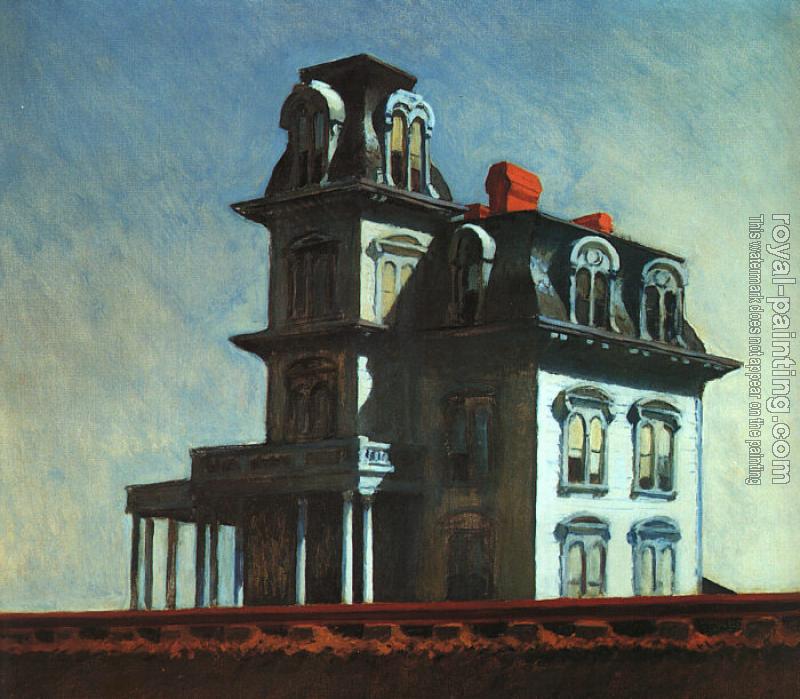 |
| E.Hopper \ House by raildoad MoMa New York |
Proprio qui a mezzogiorno in punto,
questa casa strana e goffa ha la
espressione
di qualcuno che guarda fisso, qualcuno
che trattiene
il respiro sott'acqua, in silenzio e
in attesa;
Questa casa si vergogna di se stessa, si vergogna
del suo fantastico tetto a mansarda
e del suo portico pseudo-Gotico, si vergogna
delle sue spalle e delle sue grandi e goffe
mani.
Ma l'uomo dietro il cavalletto è frenetico.
E' brutale come la luce del sole. e crede
che la casa deve aver compiuto qualcosa
di orribile
alle persone che una volta vivevano qui
Perchè ora la casa è così disperatamente vuota,
deve aver fatto qualcosa al cielo
perchè anche il cielo è completamente vuoto
e privo di significato. Non ci sono
alberi o cespugli qui -- la casa
deve aver compiuto qualcosa contro la
terra.
Tutto quello che vediamo è un solo paio di binari
che corrono verso l'infinito. Non passano
treni
Ora lo straniero ritorna in questo posto
tutti i giorni
finché la casa inizia a sospettare
che anche l'uomo è afflitto, afflitto
e pieno di vergogna. Allora la casa inizia
a guardare dritto quell'uomo. E in qualche modo
la vuota tela bianca prende
l'espressione di qualcuno che è nervoso,
qualcuno che trattiene il respiro sott'acqua.
E poi un giorno l'uomo semplicemente
scompare.
E un'ombra che si muove nel tardo pomeriggio
tra i binari, prende la sua strada
attraverso i vasti campi nell'oscurità.
Quest'uomo dipingerà altre dimore
abbandonate,
e vetrine di squallide caffetterie, e negozi
con povere
insegne nei sobborghi di piccole città.
E sempre avranno questa stessa
espressione,
L'apparenza completamente nuda di qualcuno
che sta osservando, qualcuno Americano e
goffo.
Qualcuno che sta per essere di nuovo lasciato
solo, e non può più sopportarlo.


