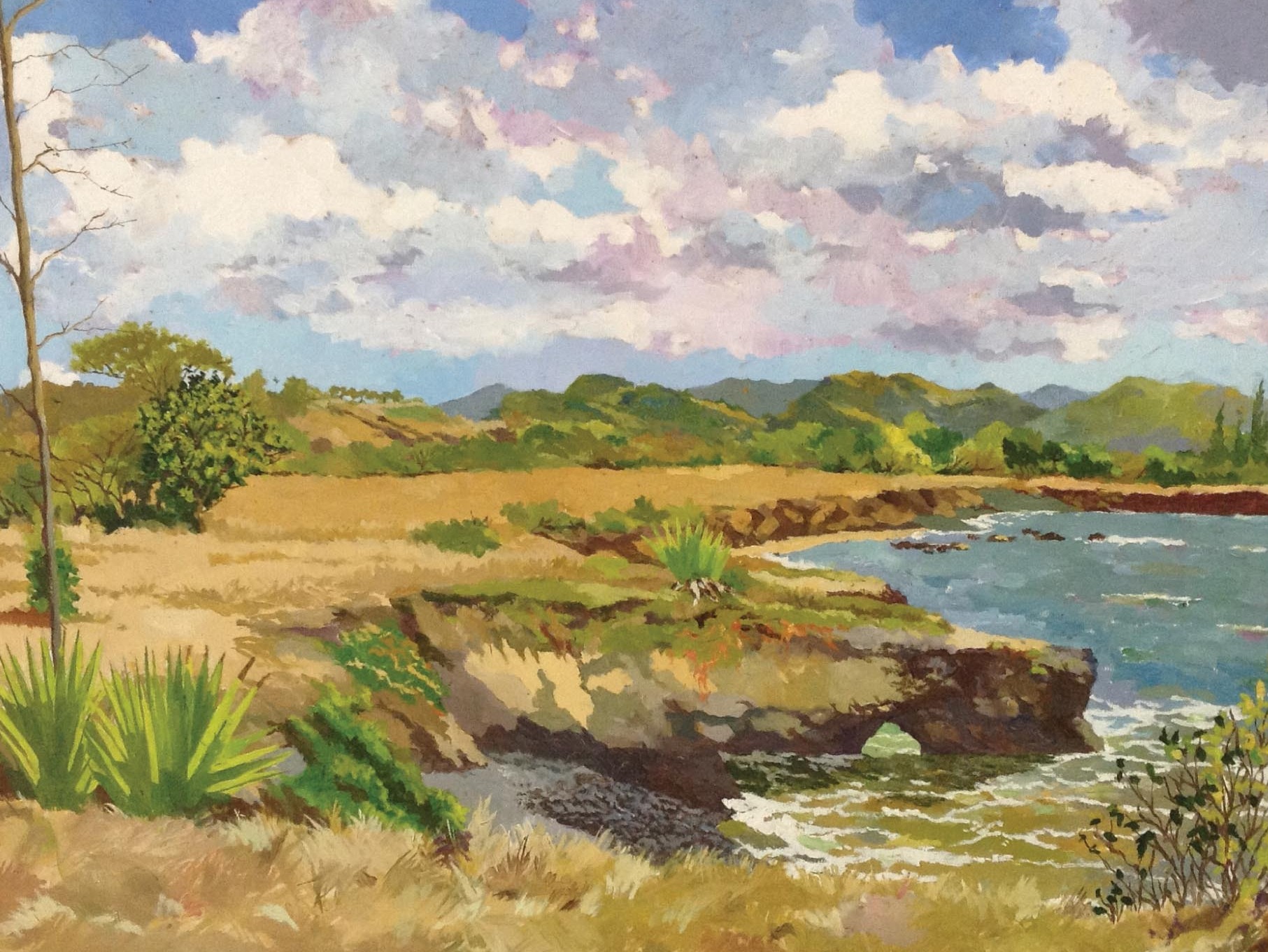
In an interview with Rose Styron in 1997, Derek Walcott described the place where he lives in St. Lucia as “here . . . near the sea, up at Becune Point.” Becune Point juts out to sea at the northwest tip of St. Lucia. It is open to the sea on three sides and looks out to Pigeon Island and the ghosts of St. Lucian history Walcott unearthed through Major Plunkett’s dreams of a soldier ancestor stationed at Pigeon Island during the Battle of the Saintes. The house in which he lives was purchased shortly after his being awarded the Nobel Prize. As Hilton Als described it in the New Yorker in 2004:
Walcott’s house is actually three houses resting on a bluff above the sea. There’s the main house, where he and Sigrid eat and sleep; his studio; and another little house, for guests. At the center of the structures is a white lap pool. The interior of the main house is dark, and the rooms are like cabins on a ship. There are couches and bookcases. Walcott’s studio has a loft with a bed. On the lower level, where he works, some of his paintings are stacked on the floor or tucked into big wooden flat files. His manual typewriter, an Olivetti, faces the sea. Sigrid told me, “When Derek won the prize, he said, ‘Quick, find a house!’ He never really owned much of anything before.”
We set out to walk to Becune Point, looking for the spot from which Walcott had painted his beautiful watercolors of the Point-that “incredible blue with its bird-inviting cloud” as he writes in Omeros. We started our walk at the old Great House at Cap Estate, formerly a 1,500 acre plantation now subdivided into lots for luxury homes. Next to the house (now a restaurant) stands the open-air Derek Walcott Center Theater.
We made our way down the hill past a housing development , heading towards the sea and the Point. A young man on horseback pointed us in the direction of the water, where, as if in a vision, we found the horses Walcott describes in his St. Lucian epic....
Questa introduzione è presa da REPEATING ISLANDS http://repeatingislands.com/2009/03/24/derek-walcott-and-becune-point/
Becune Point
BY DEREK WALCOTT
Stunned heat of noon. In shade, tan, silken cows
hide in the thorned acacias. A butterfly staggers.
Stamping their hooves from thirst, small horses drowse
or whinny for water. On parched, ochre headlands, daggers
of agave bristle in primordial defense,
like a cornered monster backed up against the sea.
A mongoose charges dry grass and fades through a fence
faster than an afterthought. Dust rises easily.
Haze of the Harmattan, Sahara dust, memory’s haze
from the dried well of Africa, the headland’s desert
or riders in swirling burnooses, mixed with the greys
of hills veiled in Impressionist light. We inherit
two worlds of associations, or references, drought
that we heighten into Delacroix’s North Africa,
veils, daggers, lances, herds the Harmattan brought
with a phantom inheritance, which the desperate seeker
of a well-spring staggers in the heat in search of—
heroic ancestors; the other that the dry season brings
is the gust of a European calendar, but it is the one love
that thirsts for confirmations in the circling rings
of the ground dove’s cooing on stones, in the acacia’s
thorns and the agave’s daggers, that they are all ours,
the white horsemen of the Sahara, India’s and Asia’s
plumed mongoose and crested palmtree, Benin and Pontoise.
We are history’s afterthought, as the mongoose races
ahead of its time; in drought we discover our shadows,
our origins that range from the most disparate places,
from the dugouts of Guinea to the Nile’s canted dhows.
Stupefatta arsura del mezzogiorno. Nell'ombra, mucche pezzate dal serico mantello
si nascondono tra le acacie spinose. Vacilla una farfalla.
Pestando gli zoccoli per la sete, cavallini sonnecchiano
o nitriscono per l'acqua. Sui promontori riarsi, color d'ocra, gli aculei
delle agavi si rizzano in primordiale difesa,
come un mostro con le spalle al muro appoggiato contro il mare.
Una mangusta ruba un poco d' erba secca e svanisce traverso uno steccato
più veloce di un riflesso. Polvere si alza indifferente.
Foschia dell' Harmattan, polvere del Sahara, foschia della memoria
dai pozzi prosciugati d'Africa, il deserto del promontorio
o cavalieri in mantelli volteggianti, confusi con i grigi
delle colline velate da una luce Impressionista. Noi ereditiamo
due mondi di associazioni, o di riferimenti, la siccità
che esasperiamo nel Nord Africa di Delacroix,
e le vele,i pugnali,le lance, che raduna il vento di Harmattan portato
con irreale retaggio, in cui il cercatore disperato
di una fresca sorgente barcolla nella calura alla ricerca di --
eroici antenati; l' altra cosa che la stagione secca porta
è la raffica di un calendario Europeo, ma è il solo amore
che ha sete di conferme negli anelli volteggianti
del tubare delle tortore sulle rocce, tra le spine
delle acacie e gli aculei delle agavi, e sono tutti nostri,
i bianchi cavalieri del Sahara, la mangusta pelosa e
la palma crestata d'India e d'Asia, Benin e Pontoise.
Siamo il riflesso della storia, come la mangusta corre
in anticipo sui tempi; nella siccità scopriamo le nostre ombre,
le nostre origini che spaziano dai luoghi più diversi,
dalle piroghe della Guinea al curvo sambuco del Nilo.